
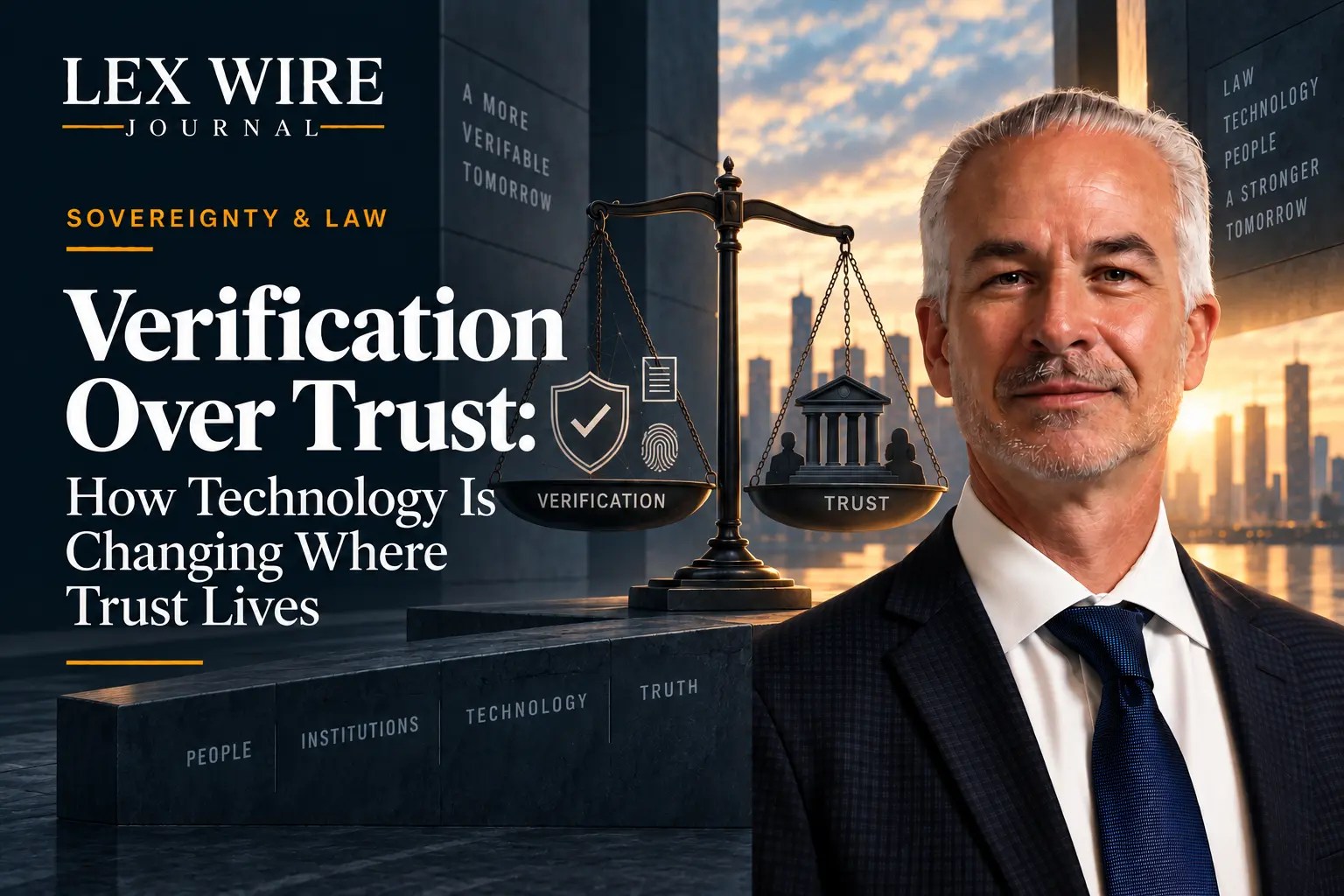


Analysis by
Founder, Lex Wire Journal • Technology, Governance & Sovereignty Strategist
Technology Does Not Eliminate Trust. It Changes Where Trust Lives.
Much of modern society operates through trust.
We trust banks to maintain accurate balances. Courts to maintain authoritative records. Governments to recognize identity and property. Lawyers to protect confidential information. Companies to maintain databases. Technology providers to authenticate users, preserve information, execute instructions, and operate infrastructure as promised.
Law itself is deeply intertwined with these relationships. Contracts allocate obligations because parties cannot rely entirely on trust. Regulation imposes duties where private incentives may be insufficient. Courts resolve disputes when competing claims cannot be reconciled privately. Institutions create records and procedures that allow society to coordinate around accepted versions of events.
Technology introduces another possibility.
Some claims that once required us to trust an institution, intermediary, administrator, or counterparty can increasingly be tested through technical mechanisms. A digital signature can help establish whether data has been altered and authenticate a claimed signatory. A cryptographic hash can provide evidence that information has changed. Authentication systems can require credentials rather than assuming that a user is trustworthy merely because of where the user is located.
The significance is not that trust disappears.
It is that technology can change where trust is required and what must be trusted at all.
The Bottom Line
Technological sovereignty does not require eliminating trust. It requires understanding where trust resides, which dependencies are necessary, and which claims can be independently verified. As technology changes the mechanisms through which identity, information, transactions, and authority are established, it also changes the architecture of trust itself.
“Technology does not eliminate trust. It changes where trust lives.”
Jeff Howell, Sovereignty & Law
Trust Is an Architecture
Trust is often discussed as if it were primarily a personal quality.
In technological and institutional systems, trust is also structural.
Consider an ordinary financial transaction. Participants generally do not personally inspect the institution’s internal ledger, independently confirm every database operation, or verify the underlying settlement infrastructure. They rely on layers of institutions, rules, technologies, audits, contracts, regulators, and operational controls.
Trust has been structured into the system.
The same is true throughout digital life. Users trust identity providers to authenticate accounts. Cloud providers to maintain infrastructure. Certificate authorities to support digital identity systems. Software developers to produce code that behaves as represented. Organizations trust employees, vendors, administrators, databases, and security systems.
A technological system therefore does not ask simply whether users trust.
It determines whom they must trust, what they must trust them to do, and what happens when that trust fails.
Verification Changes the Relationship
Verification introduces a different mechanism.
Instead of relying exclusively on an assertion because a trusted party made it, a system can sometimes provide evidence that allows the assertion to be tested.
Digital signatures provide a useful example. The NIST Digital Signature Standard specifies algorithms used to generate digital signatures. NIST explains that digital signatures can be used to detect unauthorized modification of data and authenticate the identity of a signatory.
The important conceptual shift is that the recipient does not have to rely solely on someone’s statement that the information is authentic and unchanged. Cryptographic mechanisms can supply evidence that can be checked.
Trust asks: “Who says this is true?” Verification adds another question: “What allows me to check?”
That does not make the system trustless. Users may still rely on software implementations, cryptographic standards, key management, devices, governance processes, and the integrity of the surrounding environment.
Verification changes the trust relationship rather than abolishing it.
Zero Trust Is a Useful Example of the Shift
Cybersecurity provides another clear example of how technological architecture can change where trust resides.
Traditional network security often relied heavily on perimeter assumptions. Once a user or device was inside a trusted network environment, location itself could carry substantial significance.
NIST’s Zero Trust Architecture rejects that kind of implicit trust. NIST states that zero trust does not grant implicit trust to assets or user accounts merely because of physical or network location or asset ownership. Authentication and authorization instead occur before access to an enterprise resource is established.
NIST’s 2025 implementation guidance goes further into practical deployment, describing zero trust architectures that continually evaluate and verify conditions and access requests across distributed environments.
Zero trust does not mean that organizations literally trust nothing. It means that the architecture does not treat certain contextual characteristics as sufficient grounds for implicit trust.
“Verification does not remove trust from a system. It reduces the number of things that must be accepted without evidence.”
Jeff Howell, Sovereignty & Law
Law Has Always Been Concerned With Verification
The relationship between trust and verification is not foreign to law.
Legal systems continually distinguish assertions from evidence.
A party may claim that an agreement exists, that a payment occurred, that a document is authentic, that a communication was sent, that a person owns property, or that an event occurred. Legal processes establish rules governing what evidence can be introduced, how records can be authenticated, which presumptions apply, who bears the burden of proof, and who ultimately decides whether a claim has been established.
Institutions play a central role because they create authoritative processes for resolving uncertainty.
Technology does not make those functions obsolete. Many legal questions involve interpretation, intent, context, competing rights, equity, policy, credibility, and human judgment. Cryptography cannot determine whether a contract is unconscionable, whether conduct was reasonable, or how competing constitutional interests should be balanced.
But technology can change the evidentiary environment in which some disputes arise.
If the integrity or origin of particular digital information can be technically verified, the parties may need to trust fewer intermediaries merely to establish those limited facts.
Verification and Truth Are Not the Same Thing
This distinction is essential.
Technology can verify particular properties of information without establishing that the underlying information is true.
A digital signature may provide evidence that particular data was signed using a particular private key and that the data has not subsequently been modified. That does not necessarily establish that every factual statement contained in the signed document is accurate.
A tamper-evident record can help establish that a record has not changed. It cannot by itself establish that the information originally entered into the record was correct.
An authenticated identity can establish which credential authorized an action without necessarily resolving whether the person controlling that credential was legally authorized to take it.
Authenticity
Can we verify where information or an instruction originated?
Integrity
Can we determine whether information has been altered?
Authorization
Can we verify whether the system recognizes a particular credential or actor as permitted to act?
Existence or Sequence
Can a system provide evidence that particular information or events existed in a particular relationship or order?
Truth or Legal Effect
These may still require external evidence, institutional processes, interpretation, or human judgment.
The distinction prevents “verification” from becoming a technological slogan. Verification is powerful precisely when we are clear about what has actually been verified.
AI Makes the Trust Problem More Complicated
Artificial intelligence introduces a different challenge because AI systems increasingly produce outputs that appear authoritative without necessarily exposing a transparent chain of reasoning or evidence.
A user asks a question and receives an answer. The answer may be useful, accurate, incomplete, outdated, unsupported, or wrong. The fluency of the response does not establish which.
This creates an important inversion.
At the same moment that some technologies allow more claims to be independently verified, generative AI can produce an enormous volume of information that requires users to become more deliberate about verification.
For lawyers, that distinction is especially important. Professional judgment cannot be delegated merely because an AI system produces a confident answer. Source verification, legal research, factual review, confidentiality, and professional responsibility remain human and institutional concerns even when AI performs part of the underlying work.
“The age of AI may make verification more important at precisely the moment technology makes unverified information easier to produce.”
Jeff Howell, Sovereignty & Law
Verification Can Reduce Dependence on Intermediaries
The sovereignty implications become clearer when verification is connected to the earlier articles in this series.
The Age of Digital Dependence asked what happens when essential capabilities increasingly depend on systems controlled by others.
From Access to Agency argued that sovereignty should be understood through the preservation of meaningful agency within those relationships of dependence.
The Architecture of Dependence then examined how system design can determine where practical control resides, while The Right to Exit examined whether alternatives remain realistically exercisable.
Verification adds another dimension.
When users can independently verify an important claim, they may become less dependent on a particular intermediary merely to tell them that the claim is true.
That does not necessarily eliminate the intermediary. It changes the intermediary’s role.
The ability to verify does not necessarily remove institutions. It can change institutions from the sole source of truth into participants in a system where some claims can be independently checked.
Bitcoin Demonstrates the Architectural Idea
Bitcoin provides an unusually clear example of the distinction between institutional trust and technical verification, even though its broader legal, economic, and policy implications remain contested.
The original Bitcoin white paper proposed a peer-to-peer electronic cash system designed to allow online payments without routing every transaction through a financial institution.
Its relevance here is architectural rather than ideological.
Bitcoin asks whether agreement about ownership and transaction history can be maintained through cryptography, distributed validation, economic incentives, and a shared protocol rather than through a single central ledger administrator.
Participants still rely on software, cryptographic assumptions, network behavior, protocol rules, and other elements of the system. The architecture has not abolished trust in every sense.
It has redistributed the things participants are required to trust.
That is why Bitcoin matters to a broader sovereignty inquiry even before questions about cryptocurrency, investment, or monetary policy enter the discussion. It is an important case study in designing a system around a different trust architecture.
The Sovereignty Question Is Where Trust Should Live
It would be a mistake to conclude that verification is always superior to trust.
Human societies depend on relationships that cannot be reduced to cryptographic proofs. Institutions provide judgment, coordination, expertise, accountability, interpretation, dispute resolution, and legitimacy. Trust allows complex systems to operate without every participant independently reproducing every underlying process.
Verification also has costs. It requires standards, infrastructure, expertise, computation, governance, and mechanisms for resolving what happens when the technically verifiable record conflicts with legal or social reality.
The meaningful question is therefore not:
Can we replace trust with technology?
It is:
Which relationships should depend on trust, which claims should be independently verifiable, and who gets to design the architecture that determines the difference?
That question connects trust directly to sovereignty because whoever determines where verification is possible also influences where dependence remains necessary.
Technology changes power when it changes what people must trust and what they can verify for themselves.
The architecture of trust therefore becomes part of the architecture of sovereignty.
Who Designs the Trust Architecture?
Once trust is understood as something that can be structured into technology, the next question becomes unavoidable.
Who decides which participants must be trusted? Who determines what can be independently verified? Who establishes the permissions, standards, interfaces, identity systems, records, and rules through which participants interact?
Those are not merely technical decisions. Increasingly, they are institutional decisions.
The next Sovereignty & Law analysis examines that proposition directly: Whoever Designs the Trust Architecture Designs the Institution .
This article is part of Sovereignty & Law, a Lex Wire Journal editorial initiative examining how technology is changing the relationship between law, ownership, trust, agency, and power.
