
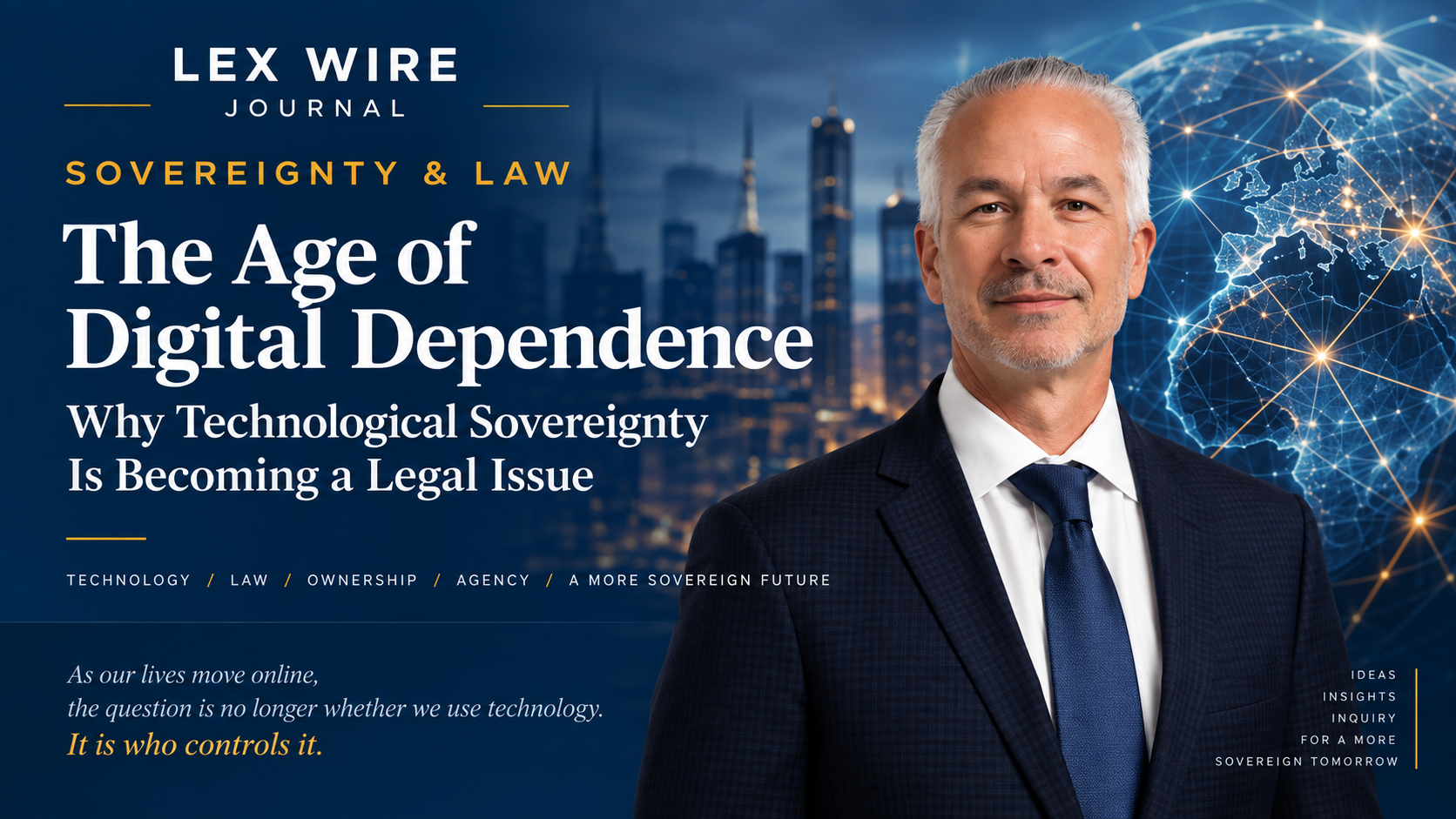

By Jeff Howell, Esq., Founder, Lex Wire Journal • AI Visibility Strategist
The Infrastructure Beneath Modern Life Is Becoming a Question of Control
Much of modern life now operates through technological systems that individuals and institutions use but do not control.
Businesses store information on cloud infrastructure they do not own. Professionals communicate through platforms operated by third parties. Organizations increasingly rely on artificial intelligence systems to search information, analyze documents, generate work product, support decisions, and extract knowledge from their own data.
Individuals encounter the same architecture in different forms. Identity, communications, payments, records, digital assets, and access to online services increasingly depend on technological intermediaries that establish the conditions under which those systems operate.
The Bottom Line
Technological sovereignty is not about eliminating dependence on technology. It is about preserving meaningful agency within relationships of dependence. As more rights, information, decisions, and institutional capabilities move through digital systems, the question of who controls the underlying technology becomes increasingly relevant to law.
This architecture has delivered enormous practical benefits. The National Institute of Standards and Technology’s definition of cloud computing describes a model built around convenient, on-demand access to shared computing resources that can be rapidly provisioned and released. Those characteristics help explain why cloud infrastructure and software services became so useful to organizations that would otherwise have to build and maintain comparable capabilities themselves.
Dependence, therefore, is not inherently a failure of technological design. The more consequential question is what happens when dependence on a system also transfers meaningful control to the party operating it.
“The defining question of digital dependence is not whether we rely on technology. It is what control we surrender as a condition of that reliance.”
Jeff Howell, Founder, Lex Wire Media
From Convenience to Dependency
The distinction becomes more important as technology moves deeper into functions traditionally associated with human judgment and institutional knowledge.
A technology provider may no longer simply store an organization’s files. Its systems may help determine how those files are organized, searched, interpreted, connected, summarized, and used. With artificial intelligence, technology can increasingly operate upon information rather than merely hold it.
That changes the nature of the dependency. The relevant questions can extend beyond possession of data to include access, portability, interoperability, verification, computational capacity, institutional knowledge, and the practical ability to continue operating if a provider changes its terms, alters its product, restricts functionality, or ceases to provide a service.
NIST’s Artificial Intelligence Risk Management Framework makes part of this dependency explicit. The framework recognizes that AI systems often involve multiple actors, including third-party developers and providers, and that organizations may rely on technologies that are complex, opaque, or governed by risk tolerances different from their own.
That is a governance problem as much as a technical one. An organization can remain legally responsible for decisions, confidentiality, risk, and professional obligations even when important parts of the technological architecture through which those responsibilities are exercised belong to someone else.
From Digital Dependence to Technological Sovereignty
This is where the concept of technological sovereignty becomes useful.
Within the Sovereignty & Law framework, technological sovereignty does not mean technological isolation or complete self-sufficiency. It does not require individuals or organizations to build every system themselves, reject cloud infrastructure, or eliminate reliance on outside providers.
Instead, it asks how much meaningful agency remains within relationships of technological dependence.
Can information be retrieved and moved? Can important claims or system behavior be independently verified? Can one provider be replaced by another? Can essential capabilities continue if a commercial relationship ends? Does the organization understand which decisions it has delegated to technology and which remain under its control?
“Technological sovereignty is not the absence of dependence. It is the preservation of meaningful agency within relationships of dependence.”
Jeff Howell, Sovereignty & Law
This distinction matters because modern technological relationships rarely divide neatly into independence and dependence. Organizations will continue to rely on vendors, platforms, networks, specialists, and shared infrastructure. The more useful question is whether those relationships preserve enough control, portability, verification, and freedom of exit for the organization to remain meaningfully capable of acting on its own behalf.
Why Technological Sovereignty Is Becoming a Legal Issue
Law traditionally establishes rights and obligations between people, organizations, institutions, and governments. But the practical exercise of those rights increasingly occurs through technological systems.
A business may legally own its data while relying on another company to store, structure, retrieve, or process it. A professional may owe duties of confidentiality while using systems operated by third parties. An organization may have contractual rights to information while lacking the technical ability to reproduce the functionality that makes the information operationally valuable.
Artificial intelligence intensifies these questions because the relevant asset may no longer be limited to the underlying information. AI systems can organize information, identify relationships, summarize institutional knowledge, generate outputs, and support decisions. This raises a further question that Sovereignty & Law will examine separately: who controls the intelligence derived from information?
Lawyers Already Face a Practical Version of the Problem
The legal profession already provides a useful example of why technological architecture cannot be separated from institutional responsibility. In ABA Formal Opinion 512 on generative artificial intelligence tools, the American Bar Association concluded that lawyers using generative AI remain subject to existing professional obligations involving competence, confidentiality, communication, supervision, candor to tribunals, and reasonable fees.
The significance extends beyond whether a particular AI tool is permissible. Lawyers and law firms remain responsible for professional obligations even when technological capabilities are supplied by external systems. Understanding what those systems do, what information they receive, how that information may be used, what risks the systems introduce, and what control the firm retains therefore becomes part of the governance problem.
Legal rights can exist on paper while technological architecture determines how easily those rights can be exercised in practice.
This does not mean software architecture replaces law. Contracts, regulation, professional duties, property rights, privacy protections, and judicial remedies continue to matter. Technology adds another layer through which those rights and obligations are exercised.
The result is a growing relationship between legal authority and technological capability. Understanding one without the other may provide an incomplete picture of who actually possesses control.
Ownership, Control, and the Ability to Exit
One of the clearest ways to examine technological sovereignty is to distinguish ownership from control.
A contract can state that a customer owns its data. That is important. But ownership alone does not answer whether the data can be exported in a useful format, whether another system can interpret it, whether workflows built around the original platform can be reproduced, or whether institutional knowledge created through that platform can move with the customer.
Portability and interoperability therefore become relevant to sovereignty because they affect whether exit is merely a contractual possibility or a practical one. NIST’s work on the Cloud Computing Standards Roadmap has long identified portability and interoperability as important considerations in cloud environments, reflecting the broader importance of moving information and capabilities across technological systems.
The ability to exit does not require that exit be effortless or costless. Complex systems naturally create transition costs. The sovereignty question is whether leaving remains realistically possible without surrendering information, essential capabilities, or institutional continuity to such a degree that nominal choice ceases to function as meaningful choice.
Technology Is Becoming Part of the Architecture of Power
Technological systems do more than make existing processes faster. Their design can determine who can participate, who can verify, who can modify rules, who can access information, who can exclude others, and what alternatives remain available.
That makes architecture relevant to questions traditionally associated with governance.
Centralized systems can offer substantial advantages in efficiency, coordination, security, support, and accountability. Decentralized or locally controlled systems can offer different advantages in verification, resilience, autonomy, and resistance to unilateral control. Neither architecture is inherently appropriate for every problem.
The important inquiry is what each architecture requires its users to trust, what powers it gives its operators, what protections exist when interests diverge, and whether meaningful alternatives remain.
“The architecture of a technological system does not merely determine how the system works. It helps determine who can exercise power within it.”
Jeff Howell, Sovereignty & Law
A New Inquiry for Law
Technological sovereignty is not presented here as a settled legal doctrine. It is a framework for asking questions that become increasingly important as technological systems mediate more of the relationships through which people and institutions exercise rights, perform obligations, make decisions, and participate in economic and social life.
Who owns the information? Who controls the infrastructure? Who can verify what the system is doing? What happens when the provider and user’s interests diverge? Can the user move to another system? And increasingly, who controls the intelligence produced from the information entrusted to these systems?
Those questions connect technological design with ownership, contracts, confidentiality, governance, competition, institutional resilience, professional responsibility, and ultimately agency.
Sovereignty begins to matter when dependence affects the ability to choose.
The challenge for law is to understand how rights and responsibilities operate when the practical conditions for exercising them are increasingly embedded in technological systems.
That inquiry leads directly to the next question in this series. As artificial intelligence moves beyond storing information and begins organizing, interpreting, and generating knowledge from it, control over data may no longer tell us who controls the intelligence.
That distinction is the subject of the next Sovereignty & Law analysis: Who Controls the Intelligence? The Hidden Governance Question Behind Enterprise AI.
This article is part of Sovereignty & Law, a Lex Wire Journal editorial initiative examining how technology is changing the relationship between law, ownership, trust, agency, and power.

About the Author
Jeff Howell, Esq., is a dual-licensed attorney and founder of Lex Wire Journal. He leads Sovereignty & Law, an editorial initiative examining how artificial intelligence, digital infrastructure, cryptography, decentralized systems, and emerging technologies are changing the relationship between law, ownership, trust, agency, and power.
His work explores how technological architecture can shape who controls information and intelligence, where institutional dependence resides, and whether individuals and organizations retain meaningful agency within the systems they increasingly rely upon.