
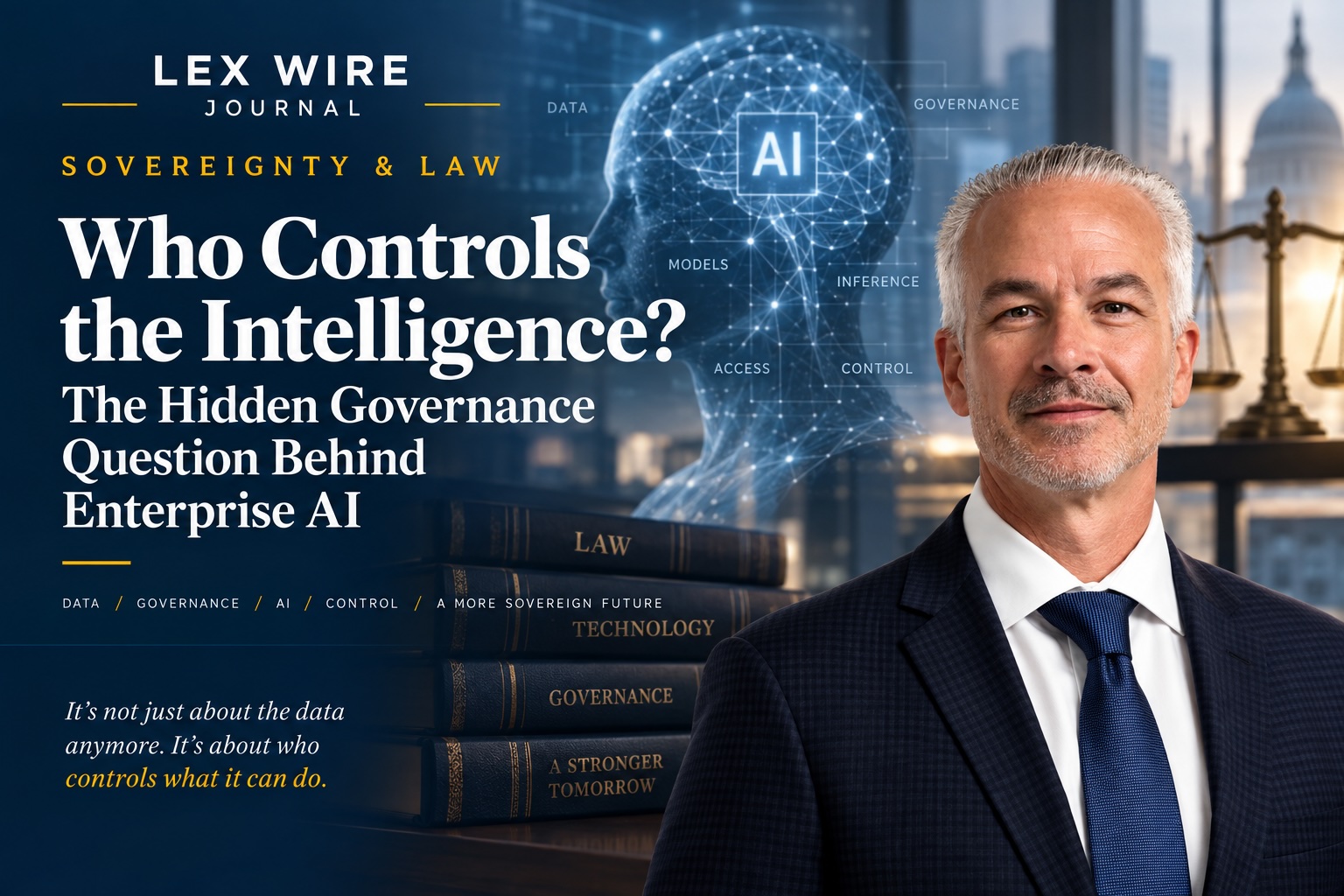


Analysis by
Founder, Lex Wire Journal • Technology, Governance & Sovereignty Strategist
AI Is Changing What Organizations Actually Need to Control
For years, organizations have treated data ownership as one of the central questions of digital governance. Who owns the files? Where are they stored? Who can access them? What happens when a vendor relationship ends?
Artificial intelligence adds another layer to that problem. Increasingly, enterprise systems do not merely store information. They interpret it, connect it, summarize it, retrieve it, organize it, generate from it, and use it to support decisions.
As that happens, the strategic asset inside an organization begins to include more than the underlying documents and databases. It includes the capability to transform those materials into useful knowledge.
The Bottom Line
Organizations have spent decades asking who owns their data. Artificial intelligence introduces a different governance question: who controls the systems that transform that data into useful intelligence? As AI becomes embedded in institutional knowledge, analysis, workflows, and decision-making, governance can no longer stop at data ownership. It must address control over the intelligence layer itself.
This does not mean that every AI-generated output becomes a new legal asset called “intelligence,” or that existing doctrines of ownership suddenly disappear. The distinction is more practical. An organization may retain legal rights in its underlying information while becoming increasingly dependent on an external system to make that information searchable, actionable, contextual, or economically valuable.
That is the hidden governance question behind enterprise AI.
“The governance question of the AI era is no longer simply who owns the data. It is who controls the intelligence that can be produced from it.”
Jeff Howell, Sovereignty & Law
From Storing Information to Producing Intelligence
Traditional enterprise technology was often easier to conceptualize. A document management system stored documents. A database stored records. An email platform transmitted communications. A search tool located material that already existed.
Modern AI systems can occupy a more active position within the organization. They may classify information, create summaries, identify patterns across large collections of documents, synthesize multiple sources, generate drafts, retrieve context, recommend actions, and become interfaces through which employees access institutional knowledge.
That shift matters because the system is no longer only a container. It becomes part of the organization’s cognitive infrastructure.
The National Institute of Standards and Technology has recognized the need to govern AI across its lifecycle rather than treating risk as a question confined to the underlying data. The NIST Artificial Intelligence Risk Management Framework is structured around managing risks associated with the design, development, use, and evaluation of AI systems, reflecting the broader reality that governance must extend to how an AI capability operates, not merely what information is placed into it.
NIST’s companion Generative AI Profile goes further by addressing risks specific to generative systems and expressly considering the use of proprietary, open-source, and third-party models and systems across an enterprise.
Once AI becomes part of how an organization interprets and acts upon its information, a new form of dependence can emerge. The organization may still possess the records, but the capability that makes those records useful at scale may reside somewhere else.
Your Data Is Not the Same as Your Intelligence
The distinction between data and intelligence is easy to overlook because the two are closely related.
Data can include contracts, emails, research, financial records, client files, internal policies, matter histories, customer interactions, operational documents, and other information accumulated by an organization. Intelligence emerges when those materials can be connected, interpreted, contextualized, and applied.
In an AI-enabled environment, that capability may depend on a combination of models, retrieval systems, indexes, embeddings, permissions, prompts, integrations, workflows, user feedback, system configuration, and other technical layers that sit between the raw information and the answer delivered to the user.
Some of those components may belong to the organization. Others may belong to a vendor. Some may be portable. Others may be difficult to reconstruct. The resulting governance problem is therefore not resolved merely by inserting a contractual provision stating that the customer retains ownership of its data.
“Data is what an organization has accumulated. Intelligence is what the organization can understand and do with it. AI makes the difference between those two increasingly important.”
Jeff Howell, Sovereignty & Law
Consider an organization that has spent years accumulating documents and internal knowledge. If an AI platform becomes the principal mechanism through which employees locate precedent, identify relationships, retrieve institutional memory, summarize prior work, or generate new analysis, the value of the underlying information becomes increasingly intertwined with the system used to interpret it.
The organization may own every source document and still face substantial difficulty recreating the intelligence capability if it loses access to the system through which those documents have become operationally useful.
The Hidden Governance Layer
Enterprise AI therefore creates governance questions that extend beyond conventional data security and privacy reviews.
Organizations may need to understand not only where information is stored, but also which models process it, how retrieval is performed, what information is retained, whether prompts or outputs may be reused, what controls govern access, how models or services can change, whether activity can be audited, what happens during an outage, and what can be exported when the relationship ends.
Those questions become particularly important when third-party systems are embedded deeply into workflows. NIST’s Generative AI Profile specifically identifies third-party considerations as part of generative AI risk management and contemplates organizations acquiring, embedding, incorporating, or using third-party generative AI models and systems across the enterprise.
The problem is not that third-party technology is inherently undesirable. External providers may offer superior models, stronger security resources, faster development, specialized expertise, and capabilities that would be impractical for many organizations to reproduce independently.
The governance issue is whether an organization understands which capabilities it has delegated, what dependencies those choices create, and what meaningful control remains if the provider’s incentives, pricing, technology, policies, or availability change.
AI governance is incomplete if it governs how employees use artificial intelligence but ignores who controls the infrastructure through which organizational intelligence is produced.
Why Enterprise AI Makes the Question More Urgent
A stand-alone productivity tool creates one level of dependency. An AI system connected to an organization’s accumulated knowledge creates another.
The deeper an AI system reaches into internal documents, communication histories, customer records, research, workflows, decisions, and institutional memory, the more the system can become intertwined with how the organization itself operates.
That creates a form of value that may be difficult to measure using traditional software procurement categories. The organization is no longer buying only a tool. It may be building part of its institutional cognition through that tool.
This distinction becomes especially significant as AI interfaces begin replacing conventional search, knowledge management, and software navigation. When employees increasingly ask an AI system what the organization knows, what happened before, what documents matter, or what action should come next, control over that interface can begin to influence control over institutional knowledge itself.
Law Firms Make the Problem Easier to See
Law firms provide a particularly clear illustration because the information flowing through their systems can include privileged communications, confidential client information, legal research, attorney work product, matter histories, strategic judgment, internal know-how, and the accumulated experience of lawyers across the firm.
When AI is introduced into that environment, the firm’s responsibility does not transfer to the technology provider. ABA Formal Opinion 512 states that lawyers using generative AI must continue to consider professional duties including competence, confidentiality, communication, supervision, candor to tribunals, and reasonable fees.
The confidentiality analysis is especially revealing. ABA guidance emphasizes that lawyers must understand enough about the technology they use to evaluate the risks associated with disclosure of client information. That inquiry necessarily reaches beyond the quality of the model’s output and into questions about how the system handles information and how third parties may interact with it.
But confidentiality is only one part of the larger sovereignty question. A firm can satisfy a confidentiality requirement and still become deeply dependent on an external intelligence layer for research, precedent retrieval, document interpretation, matter strategy, drafting, knowledge management, and workflow.
The strategic question is therefore broader: what parts of the firm’s accumulated intelligence should remain portable, independently accessible, or under the firm’s direct control?
“A law firm may own every document in its repository and still outsource much of its practical ability to understand what those documents collectively know.”
Jeff Howell, Sovereignty & Law
Ownership Is Only One Layer of Control
Data ownership remains important. Contracts should address ownership, confidentiality, permitted use, retention, security, deletion, and related obligations. But AI makes it increasingly difficult to treat ownership language as the end of the governance analysis.
Practical control can depend on whether an organization can retrieve its underlying information, preserve metadata and relationships, move relevant indexes or configurations, reproduce workflows, maintain access to institutional history, integrate another model, or continue operating without losing the intelligence capability employees have come to depend upon.
In other words, an organization may legally own the inputs while another party controls crucial parts of the mechanism through which those inputs become valuable.
This is not unique to artificial intelligence. Technology has always created forms of vendor lock-in and infrastructure dependence. AI raises the stakes because the dependency can increasingly attach to the organization’s ability to interpret its own accumulated knowledge.
Where Should Institutional Intelligence Live?
There is no universal answer.
Some organizations may reasonably choose highly centralized AI platforms because the benefits of scale, performance, support, security, and rapid development outweigh the risks of dependency. Others may determine that particular information, capabilities, or workflows require more direct control.
The relevant architectural choices can exist along a spectrum. An organization might use fully hosted software, dedicated cloud environments, private model endpoints, firm-controlled knowledge repositories, hybrid systems, locally operated models, or combinations of these approaches.
The sovereignty framework does not assume that the most decentralized or locally operated architecture is always superior. It asks a different set of questions.
What information is strategically important?
Which intelligence capabilities are becoming essential to the organization?
Who can change the conditions under which those capabilities remain available?
Can the organization independently verify, export, replace, or reconstruct critical components?
What happens if the provider relationship ends?
These are not simply questions for information technology departments. They affect enterprise governance, procurement, risk management, legal strategy, information security, business continuity, and long-term institutional resilience.
A New Governance Question for the AI Era
The first era of digital governance focused heavily on information. Organizations learned to ask where data was stored, who could access it, how it was secured, how long it was retained, and who owned it.
Those questions remain essential. AI does not make them obsolete.
It adds a new layer.
As artificial intelligence increasingly determines how information is interpreted, retrieved, combined, and acted upon, organizations will need to understand not only who owns their information, but who controls the infrastructure that converts that information into institutional intelligence.
The next frontier of AI governance is not simply data governance. It is intelligence governance.
The organizations that understand that distinction will be better positioned to decide which capabilities can safely be delegated, which should remain portable, and which forms of institutional intelligence are too important to surrender to architecture they cannot meaningfully control.
That leads to a deeper ownership question. If an organization owns its underlying information but depends on someone else’s systems to interpret it, connect it, and make it useful, what exactly does ownership mean in an AI-mediated environment?
That question is the subject of the next Sovereignty & Law analysis: Your Data Is Not Your Intelligence: Why AI Changes the Meaning of Information Ownership.
This article is part of Sovereignty & Law, a Lex Wire Journal editorial initiative examining how technology is changing the relationship between law, ownership, trust, agency, and power.
